

Types of Creative Careers: A Complete Guide
At a young age, we tend to dream big, not having to worry about the responsibilities of life. For example, when I was young, I knew I wanted to be an artist, but as the years went by, this answer often changed. When we’re exposed to life’s challenges or experience setbacks, oftentimes the dream takes a back seat. And some of us get lucky and land the dream job.
But the path of find the creative career can be a challenging one. And from personal experience, it was about not knowing what type of careers were available for creative people and how to begin that journey. Sure, there was the internet, but it only got you so far and was on the verge of becoming saturated. And asking AI was out of the question, as this did not exist at the time.
Fast-forward to today, and we now know what a creative career is and consists of. It is defined as a profession that primarily utilizes a person’s artistic, innovative, or creative skills. Since times have evolved, so have creative careers–these are now more diverse than ever before, expanding from digital, tech to social sectors.
Whether you’re a student, an artist, or thinking about finally taking the leap and chasing that childhood dream, this blog is for you. We explore the different types of creative careers, the income they provide, the path you can begin to take, and more. Let's dive in!
🤔 What Are Creative Careers?
Creative works are defined as original and tangible expressions, whether produced artistically, intellectually, or scientifically. They typically involve transforming ideas into a finished body of work. And this can be across several media types, such as music, books, paintings, software, and even films. But let’s break this down further.
Creative careers require a core set of skills across the different media types. This includes:
Creative problem-solving
Innovation
Communication and collaboration
Project management
Professional mindset
Research and Analytical skills
But don’t panic if you don’t have all of these skills right away. Not everyone possesses every skill listed; some take time to acquire and develop. Remember, in any profession–whether creative or non-creative–you have to start somewhere.
The landscape of creative careers has transformed significantly over the years. It wasn't as diverse as it is today. In the past, pursuing a creative role was often rigid. Traditional creative roles were mainly confined to static media, characterized by hierarchical environments and very much siloed. A person would have to be an expert in a single discipline.
Today, with the evolution of the digital industry, the scenario has changed drastically. There is a wide range of creative careers available today, allowing individuals to have a multidisciplinary skill set that encompasses various roles. Flexibility, technical literacy, and adaptation are highly desired in these positions.
👉🏻 Creative Career Paths (How People Actually Get These Jobs)
Each of us has a different journey that we take. This is true when it comes to our dream job or career. For example, if you’ve always wanted to become a teacher, you would take the necessary classes or programs that lead you to become a teacher. If you loved helping people and wanted to become a nurse, you would take the steps to become one; the same goes for any other career path. But now it's more nuanced. Back then, there were more traditional paths to education to achieve your goal. With technology, there are so many options a person can take now to achieve the same rerouting around the traditional path.
Traditional education vs self-taught paths
The traditional path may have looked something like this: defining what you loved to do, deciding to shape your education around said path, then pursuing higher education to strengthen the niche, participating in an internship to build up experience, and finally landing the job. Now, let's look at the flipside of things. Today, with tons of singular experts having YouTube channels, TikTok, Instagram, or any other of the social platform, education has entered mainstream en masse. You don’t even have to pay thousands of dollars in tuition fees at a university anymore; all you need is access to a computer and WIFI.
But choosing an educational path is still very much needed in order to obtain that dream. Just because we’re now in an advanced tech era doesn't mean that the traditional education path is completely out of the picture. Some people work extremely well in traditional settings and want to collaborate or participate in group activities. In this case, I have to hand it to traditional education; this does help build and strengthen social skills for any environment.
Portfolio-based careers explained
Portfolio-based careers aren’t linear; they are vastly complex. This modern work model allows an individual to generate income through multiple revenue streams, and it can be done simultaneously, rather than relying on a single (full-time employer) FTE. These types of careers are now defined as the “multi-hyphen” or “slasher,” which you can very much see on LinkedIn. Just take a look at anyone’s profile.
But this does have some perks to it. For creatives, this means they can selectively curate a meaningful collection of work that reflects their style, display skill set(s), and work ethos–with ease and flexibility. Instead of having that 9-to-5 job, a person can freelance part-time or full-time. You’ve probably heard these so-called “side-gigs” which consist of working 15 to 20 hours per week. And they don’t just have to be at an agency, this could consist of either selling prints online, writing ebooks, or creating your very own social channel where others can subscribe to. It’s the most creative freedom one may choose to have.
Freelance vs full-time vs hybrid careers
There are pros and cons to freelance, full-time, or hybrid careers, but that depends on what you prioritize the most. Is it financial stability? Is it autonomy? Benefits? Let’s dive in.
Freelancing offers diverse projects an individual can work on, which can lead to a strong portfolio and high earning potential. It allows for flexible work hours. Instead of having a boss, you are the boss. But this does come with its cons: inconsistent income at times, no PTO, and partial benefits–because having all benefits is costly. It can be isolating at times, and work-life balance can often blur together. Freelancing is a high-risk, high-reward career path, but it is doable! You just have to be aware of the cons before considering this your path.
Full-time careers provide stability. So if freelancing isn’t your cup of tea, perhaps corporate life is. This career path gives you financial stability, benefits like health insurance, retirement plans, PTO, and other incentives. It provides a better work/life balance and acts as a safety net for individuals looking for a stable life, steady growth, and for those who thrive in collaborative environments. But, this also has its disadvantages. Office hours are strict, and career advancement may take a long time. Most likely, you will encounter red tape with creativity and have a hierarchical system for approval. But if stability is what you prioritize the most, then FTE careers are for you.
Hybrid careers are more nuanced. These boomed in society during the COVID epidemic. And to be honest, these types of careers are the best of both worlds. While they offer steady and long-term contractual work, hybrid careers allow flexibility and stable pay. This path gives individuals the peace of mind when it comes to a steady income, flexibility (geographically) and hourly. In some cases, this career path can be higher pay than a permanent salary. So if you still don’t want to give up your side hustle, then this path is for you. But let’s take a look at the cons. Because hybrid careers embody both FTE and Freelance, this means that sometimes income may not always be guaranteed. Mainly because contracts do come to an end at some point, and benefits might still be limited in this role.
Career ladders within creative industries
Career ladders are commonly known as entry-level, mid-level, and executive-level. Creative careers have the same structure. One cannot simply jump into a mid-level creative career without having some foundational experience. Let’s take a Graphic Designer position, for example. You would start as a junior designer with basic learning skills. From there, you would move into a mid-level designer position, gaining valuable project experience. Eventually, you will advance into a senior designer with a more robust project portfolio, before bumping up to the Art Director role.
With this in mind, some trends are circulating in creative career ladders. Instead of moving up, some professionals are opting for “creative loops,” which involve moving sideways in different disciplines to broaden their skillsets. Let’s take the same graphic designer position. Say you’re a mid-level graphic designer, instead of advancing to senior, you slide over to a user experience (UX) position. These skillsets complement each other, not only in marketability but also in leadership potential.
💰 Salaries & Income Potential in Creative Careers
Salaries differ from one ladder to the next; this isn't new. Entry-level positions are vastly underpaid compared to senior-level positions. This is usually because entry-levels do not have the same skillset or the same amount of corporate experience. However, everyone has to start somewhere. Yes, there are some places that do pay a slightly higher wage for entry-level positions, but this is rare. Some key factors that set each ladder apart are:
Entry-level creative salaries include: 0-2 Years of experience, preferably in foundational work, execution, and learning workflows. These roles typically earn anywhere from ($30k-$60k).
Mid-level creative salaries include: 3-5 years of experience, serving as the core design team, basically beefing up your project experience. These roles typically earn anywhere from ($55k-$90K).
Senior-level creative salaries include: 5-10+ years of experience, managing complex projects, mentoring junior designers, and creative strategy experience. These roles typically earn ($80k-$160K).
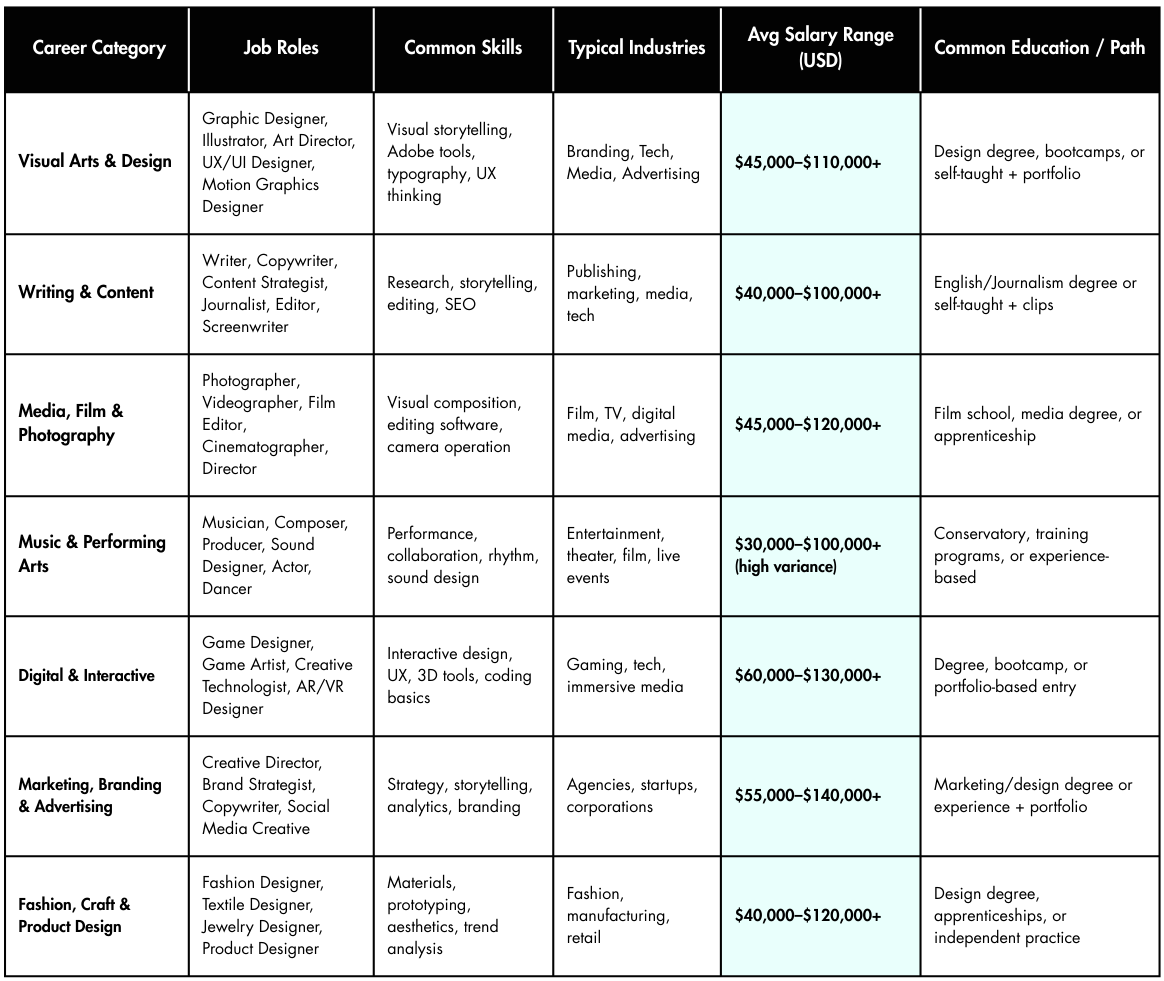
When it comes to which type of creative career path you choose, freelancing does have the potential to surpass a senior-level creative career, as mentioned earlier. Freelancing has the geographical flexibility to pursue multiple projects of all types, versus a designer in a corporate position–typically earning anywhere from $40k to $100k+. (See table below for further examples of types of career positions, pay, and educational path.)
High-earning creative roles do require extensive experience, but also from a business standpoint. These roles tend to blend artistic vision with strategic business goals. If you are considering this, make sure you do your research. But let’s not ignore the elephant in the room. Just because we have entered a different era of creative careers, where multiple skills are desired and specialization remains in demand, does not mean pay is unaffected. Specialization helps you to stand out in a niche market. By focusing on in-demand skills, you improve efficiency and quality, which businesses are willing to pay more for.
No matter which level you are in or want to be in, there are some things to consider: experience, project knowledge, leadership experience, etc. Each has its own path. But for those looking to switch careers with little to mid-level creative experience, following the trend of doing a “creative loop” may be a good way to reach the next level without starting from scratch.
📋 Major Categories of Creative Careers (With Salary & Education Paths)
🏁 How to Start a Creative Career: Step-by-Step
Knowing where to start on your creative career path is the puzzling part. Some people are good about doing their own research, but not all of us are that meticulous. This part could be overwhelming, especially for those of us who are overthinkers. But to ease your anxiety, here are some questions you need to answer that will make this much simpler, and a starting point:
Step 1: Identify your creative strengths. What is it that you are really good at? Is it taking really good photos? Creating content? Sculpture? Write your strengths (along with the weaknesses) down.
Step 2: Choose an industry & role. After identifying your strengths, these typically can be categorized into an industry. For example, if you LOVE taking photos, then Photography is most likely your chosen industry.
Step 3: Build a portfolio (what matters most). Let’s extend from the last step. Begin experimenting with types of photography; this could be analog or digital, it doesn’t matter. Then build a body of work; you do not have to be perfect, just do. This helps you get familiar with the craft.
Step 4: Gain experience (internships, freelance, projects). You can do this through an educational route or continue with self-teaching. Either path you choose, make sure to get an internship, or jump into some freelancing opportunities to build upon. This increases your experience and hones in on your skillset.
Step 5: Network & find opportunities. This step is crucial. In my personal experience, it’s about networking and meeting other photographers, or artists who are more advanced to help guide, offer their wisdom, or connect you with a potential client/profession/or curtator. You never know!
Whatever you do, don’t sweat the small stuff. Writing things down is the easiest path to clarity, and try not to overthink things. This will only confuse you and delay your journey. If you’re switching careers, this also applies to you. Assessing where you’re currently at and identifying where you want to go is a sure way to allow you to pivot with ease.
👏 Best Creative Careers for Artists: By Personality & Strengths
The world we now live in has so many options when it comes to career opportunities that are better suited to our types of personalities. We no longer have to force ourselves into a career that we will loathe, but first, you have to identify which type of personality you are.
If you’re an introvert and thrive in minimal in-person interaction, autonomy, and quiet environments, then these are the best creative careers for you:
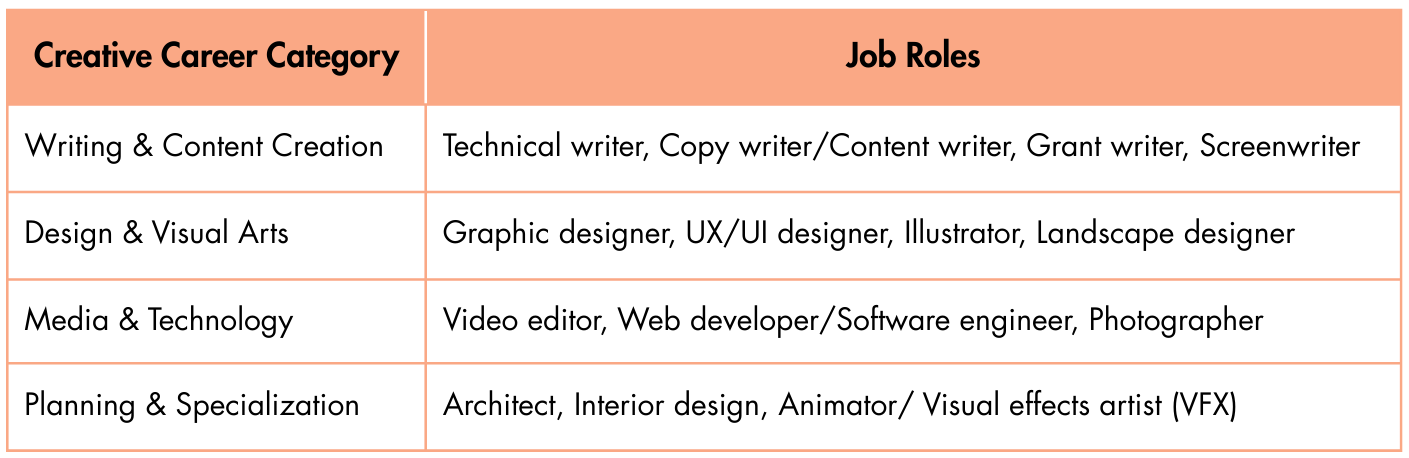
If you love to problem-solve and thrive with complex issues through creative strategies, then these are the best creative careers for you:
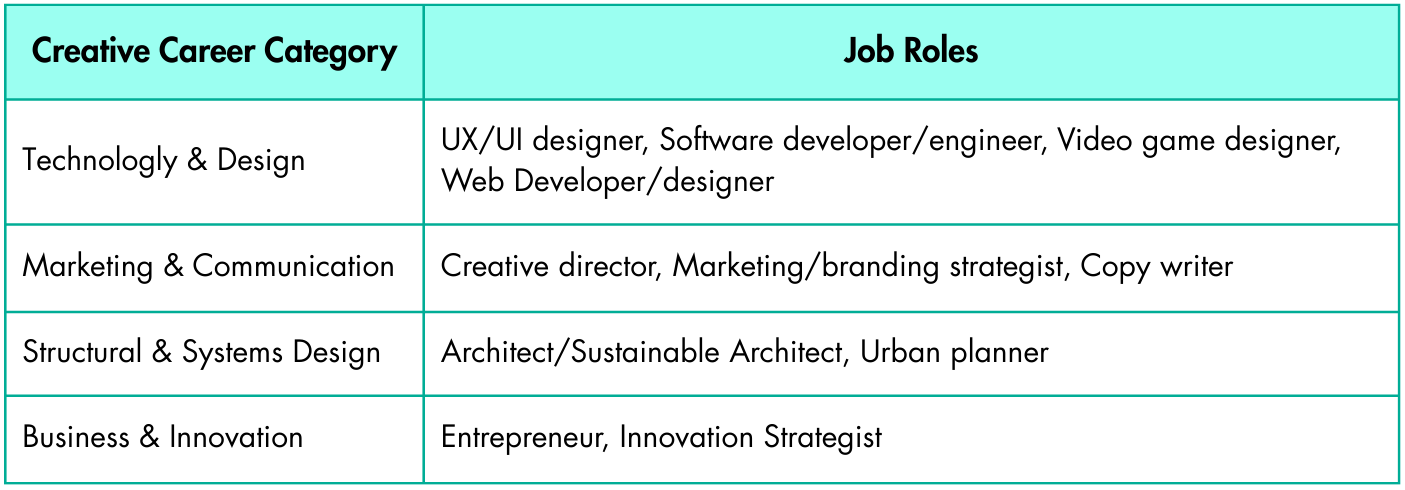
If you have the knack to process information, problem solve, or recognize patterns through mental imagery, then these are the best creative careers for you:
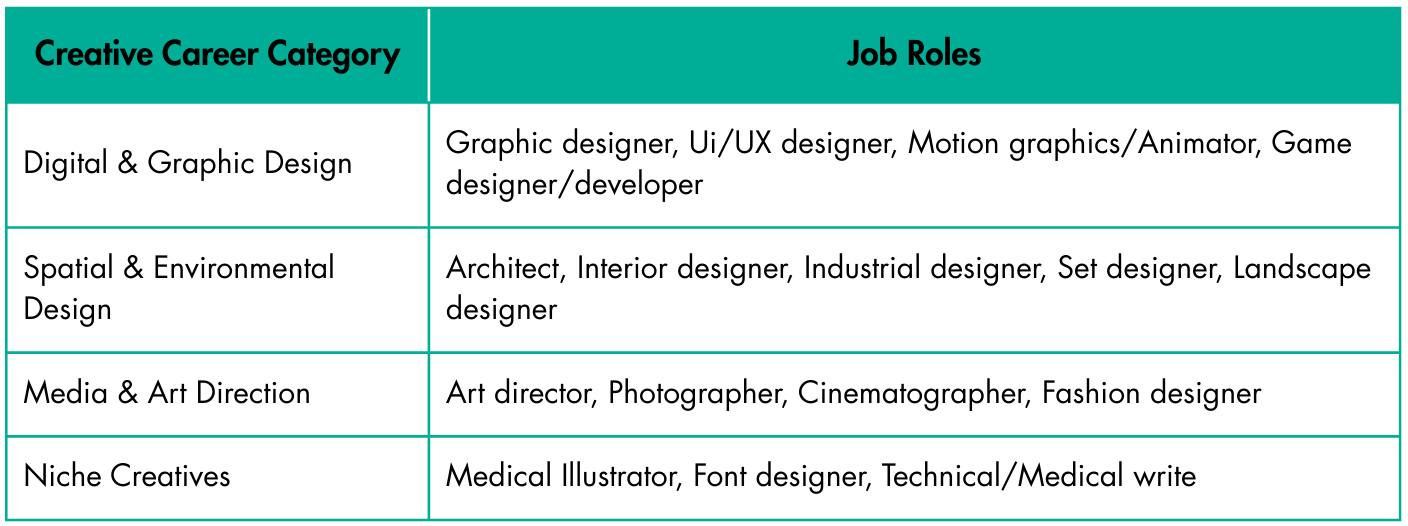
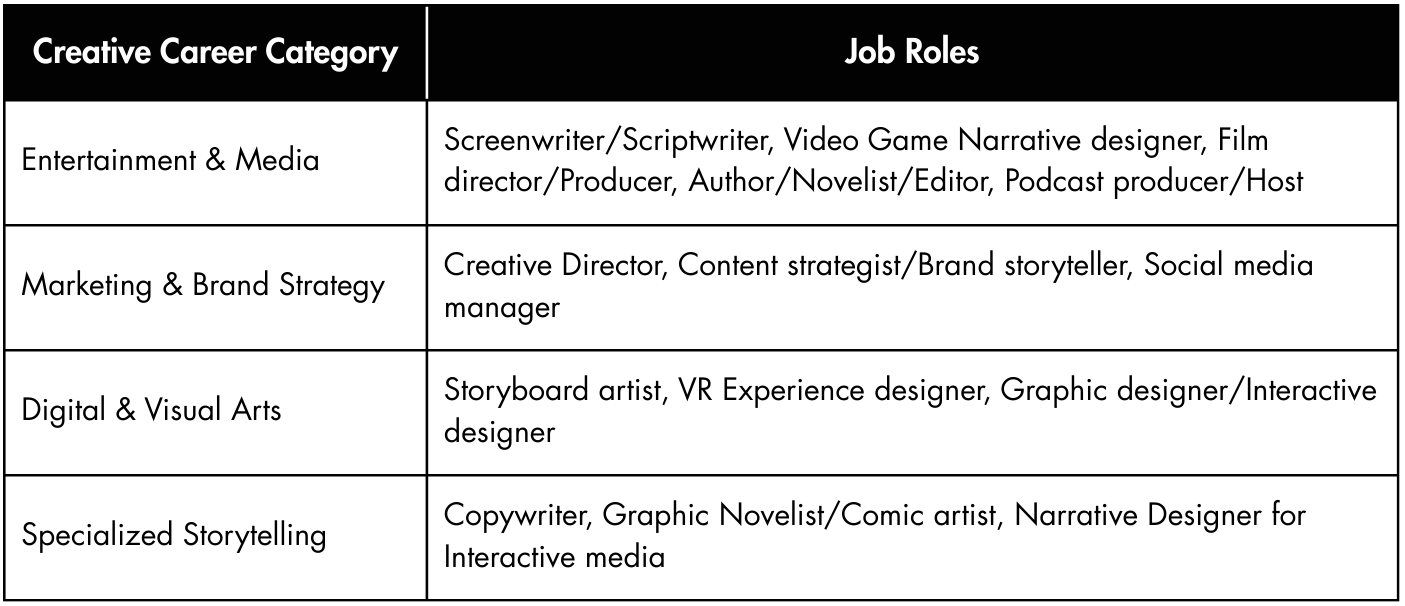
If you’re the type of person who loves telling stories or has the talent of creating compelling narratives that engage people, then these are the best creative careers for you:
😰 Common Challenges in Creative Careers and How to Overcome Them
When pursuing a creative career, it’s important to look at the cons to know what you’ll eventually have to face (if you’re just starting).
Income instability is one of these hurdles. As stated before, if you’re seeking the freelance, entrepreneurial path, these tend to be sporadic at times and may cause a financial gap when one project is completed. It is very important to be financially conscious when taking this role. One way to avoid a financial gap/pause is to plan–always be one step ahead. This may look like building a savings cushion (to survive the in-between), locking in long-term contracts instead of short-term, or expanding a skillset so you do not have to rely on outsourcing work.
Burnout and creative blocks are another type of daunting hurdles. Every artist I have come across has experienced this multiple times throughout their careers, even I, included. This is completely normal. Burnout may come after overproducing a body/bodies of work, or if working in a high-demanding corporate job. And when you experience burnout, creative blocks usually follow. One way to combat this is not to force yourself to be creative during this phase. Take a break, or allow yourself to rest. It’s about acknowledging the blocks, how to recognize the next creative wave, and when to ride it when that wave comes. But if you’re still not convinced, check out a previous blog I wrote that gives some pointers on how to approach creative lows.
Imposter syndrome can also be challenging. And, if I must admit, we all have fallen victim to this. When we look outward for inspiration or to gauge where we need to be, it’s easy to fall into this trap! As artists, we sometimes work in a tunnel, without the ability to zoom out and appreciate how far we’ve come. We experience this because when it comes to creative growth, there aren’t clear milestones to gauge the artist’s journey. Unlike corporate ladders, creative careers rarely have clearly defined markers, making ‘success’ feel unearned or accidental. There are ways to combat this, but one way is to document your journey. This could be in a journal, a folder of good feedback, or an artist's CV. It is the BEST way to see your growth, and all visual artists must have this if they choose to become professionals at their craft.
Last, but not least, trying to stand out in competitive fields can also be difficult. Positioning your work amongst the crowds is tough work in and of itself. With social media accessible, a lot of new artists have become masters at leveraging the platforms, making it easy to fall into the shadows of a technological abyss. Even trying to get traffic to your website takes some marketing elbow grease. Willingness to learn, grit, and resilience are the key elements to help combat this. By shifting your mindset to be willing to learn new technologies and adapt to new challenges shows you are a long-term asset. Highlighting your story of overcoming failure, dealing with life’s disruptions, and how you’ve adapted to these will not only keep you motivated but also create a supportive environment.
😌 Bottom Line
With all this in mind, the future of creative industries has expanded exponentially, for the better! If we look back on how far the industry has evolved, it is truly something to be proud of and excited to venture into. We no longer have to accept the dreaded comments of “How are you going to make a living off of your art?” Our creative industry has made it easy for us to achieve this, and with speed.
Venturing into a creative career has its advantages. There’s no reason why you cannot pursue a creative career today; the opportunity is present. Whichever path you choose, don’t be afraid to start. Our artistic careers will never be straightforward, and never let the non-linear option scare you either. Lean into the unknown, and it may surprise you.
Visit our blog page for more creative reads!